Showing posts with label depression. Show all posts

Tuesday, September 4, 2018

How Often Do You Ask For Permission?

Have you ever asked a question of someone - significant other, friend, coworker, parent, kid, pet, etc - and immediately afterward caught yourself asking, "Why on earth did I need to ask them that?". I do it, all the time. And to clarify, not any question. I'm not talking philosophical discussions or quizzo facts. I'm talking about asking permission for silly things that absolutely don't require it. Here are a few examples:

"Do you mind if I use the bathroom before I start on xyz?" Yes, I've asked probably every person regularly in my life, at one point or another, if they mind if I do essential things like use the bathroom.

"Is it OK if I wear this?" Not to anything specific that would impact the person/people, to clarify. Just to make sure they're OK with it, I guess. Because I'm always afraid I've chosen wrong somehow.

If I'm not asking people's permission, I'm asking their opinion, in almost a permission-y way. I'll be sending an email about something and read it out loud to them to make sure... that I know how to write an email? I don't even know why. I was the VP of communications for a big organization. I have a Master's in Marketing. I am a published writer. I know how to write and communicate. There's zero point in my painstakingly seeking approval from others for a basic email. But I'm so sure I somehow got it wrong that I ask, "just in case". 

I ask people's opinions on how to cook something as I'm staring at a recipe because I don't trust myself to even find a good recipe. I ask how to wash something as I'm staring at the laundry label, because I doubt myself. You get the picture. I'm always certain someone else knows better than me, in everything.

I'm a chronic permission asker. When you battle with depression, your brain often lies to you. It tells you that you're not good enough, that you don't know anything, that you're not capable. It tells you that if someone claims to know better, you should just believe them because really, what do you know? After all, your brain makes you feel anxious or depressed "for no reason."  (Note: this isn't true, the reason is an illness, but it's how depression makes you feel.) You've been convinced not to trust your views, your thought process. Because you often see things differently, more emotionally, it's easy for depression to convince you that you aren't logical and therefore can't possibly come to the right conclusion. Because of these lies, and the chronic low self-esteem and self-worth that often result, its easier to fall into permission and opinion asking as a default, instead of trusting ourselves.


Let me step back and take a moment to further clarify, I'm not asking about permission to do something that actually affects someone else. Of course, I'm not going to spend tons of money out of our joint banking account without asking my husband. I'm not going to make plans that include a friend without checking with them, or make plans on a Tuesday that don't include my friend, if we have a standing Tuesday friend-date together. I'm not saying we should live our lives in a bubble, thinking only of ourselves. Far from it. Considering others when it could/does affect them is just common courtesy.  I'm talking about things that, in all reality, don't affect another person's time, money, plans, efforts, etc. I'm talking about things that don't take anything away from anyone else. Most of the time, when I ask permission, it's not something that I'm asking out of consideration. I'm simply asking because it's become automatic - I never want to upset anyone or do the "wrong" thing, so I'm overly cautious about making sure everyone is OK with everything. And I don't trust my brain to make this type of decision.

The problem with being a chronic permission asker is that it further feeds the cycle of low self-esteem and self worth. The more you ask permission and opinion for these tiny mundane things, the tougher it is to do anything without others' approval. And if you do, and there's any disagreement/criticism/critique/it doesn't go right, it makes you feel like you should have just asked and listened to them in the first place. It becomes increasingly difficult to trust yourself, your thoughts, your opinions. Eventually, you become afraid to think for yourself, because surely, you'll be wrong. Might as well just by-step the "middleman" and go straight to the source - someone else. One day, you wake up and realize that you don't recognize your own thoughts or ideas. You don't recognize yourself. You're now this being made up of everyone else's thoughts and opinions. You're literally afraid to do basic, every day things, make simple decisions - even ones that you previously would have been confident in - without someone else's approval and permission, because your brain is so sure you'll do it wrong.

So stop. Stop asking permission for the things that don't matter. Nobody's worse off if you wear one shirt over another (assuming it's not their shirt you're choosing to wear). If you use the bathroom now or in 10 minutes. If you feed the dog or do the laundry or some other basic task now or in a half hour. Nobody's worse off if your wording in that email isn't exactly as they would have worded it (assuming you aren't strewing in profanities or inappropriateness or speaking on behalf of someone else without their consent... you get the point). If follow a recipe and it's not perfect ... well, it's not perfect. I'll eat something imperfect or order a pizza. It's just not that big of a deal, and it's not worth lowering your already low self-esteem by feeling like you can't trust yourself on these tiniest decisions and processes.

In constantly allowing others' permission or approval to determine your actions, thoughts, words, you're giving them control. And I don't mean control we all deserve - i.e. having a say in something that directly will impact us - but control they have no business having. As an adult human being, nobody but you should have control over your bathroom usage or which pair of jeans you wear or how you style your hair or anything else. It becomes a slippery slope - one that's dangerous for your self-esteem and self-worth. So give yourself permission. I know this isn't easy. Depression and anxiety don't want to let you do this. But it's so important. Listen to yourself. After all, you know you better than anyone else. And you're way more capable and able than your illness wants you to believe.

Thursday, August 16, 2018

If You Wonder What It's Like To Have a Rapid Cycling Disorder, Watch the Whether

Not sure about where you live, but here in Philly, the whether has been fluctuating between drastically hot and sunny and Armageddon. This past week people were being rescued from roofs of their cars due to flooding on our major highways. Intense storms toppling trees, thunder pounding, lightening illuminating the sky.  And then twenty minutes later, I'd be putting on my sunglasses. Storms have been rolling through so quickly and tumultuously that streets are being flooded out in a matter of minutes when there were no clouds in sight just an hour before.

This, folks, is what its like to have a rapid cycling mood disorder. At least mine. Of course, I can't speak for everyone. Technically, rapid cycling is described as four or more mood cycles in a year. For me, it can be four or more cycles in a week, or even a day. Of course, this isn't always the case - and four cycles in a day is extreme even for me. But truly, I do go to bed every night having little inkling of how I'll feel in the morning. And even once I wake up, my mood often does not predict how I'll feel by lunch time, let alone the end of the day.

To clarify, it's not as drastic as they'd show in Hollywood, where I just completely do a 180 mid-sentence and you can't recognize me. In fact it's nothing like that at all.  I can feel the cycle coming on, when I'm awake at least. I'm especially on alert if I know there are contributing factors that tend to make me cycle - lack of sleep, for instance. Or too much external stimulus, a major change to my routine, not getting enough recoup time/self-care time. In these cases, much like watching the whether radar patterns, I can pretty well anticipate that I'm going to cycle.  But no matter how prepared you are, sometimes there's only so much you can do. You can try to time your day out perfectly, analyze all the weather forecasts, diligently study the radar, and still get caught outside when the skies decide to open up. Because sometimes, shit just doesn't go like you or anyone else thought it was going to.

So if the whether has left you frustrated these past couple of weeks, pouring down with little warning and turning sunny the minute you cancel all of your outdoor activities, know that I can empathize. This is my brain on any given day. And no matter how much you try to prepare, to do everything correctly, to take all the precautions, to carefully listen to all the storm warnings and predictions, sometimes you miss the mark, or the storm changes course swiftly and there's nothing you could do to change it.  And when that happens, you get to a safe space as quickly as you can and, as one apparently only does in big storms or serious flareups, hunker down until it lightens up.

Thursday, July 26, 2018

Look Ma, No Meds

It's been a while since I've written. I've been going through some stuff, both enjoyable and .... less so. I was traveling to Spain, which was amazing. I was in a car accident that possibly totaled my car (I'm ok), which is not amazing. But mostly, I've been titrating down on my medication. I've been doing so since January, with my therapist/heath care team overseeing it every step of the way.

I'm decreasing my meds for personal reasons that I'm not ready to share yet, but I will say that it has nothing to do with my mental health. By which I mean, I'm not decreasing them because my health has gotten so much better that I don't think I need them. On the contrary, I have a lifelong condition and I know that one of the only reasons I feel relatively better regularly is my medication. Nor am I doing so because of anything wrong with my meds, or because I've become one of those people that thinks medication is evil and makes me a "pawn of the system".  Far from it.  Medication has most likely saved my life, and despite the nausea, dizziness, disorientation, numbness in my tongue and lips, and my personal favorite, the never-awkward intense night sweats, the side effects of my meds are not all that bad - especially not compared to I feel when not taking them. But I have my reasons, and they're good ones (at least I think so), and hopefully one day I'll be able to share them. Just not yet.

Still, I wanted to share my experience of decreasing meds, as well as some tips and some real talk, in case you find yourself in a position where you need come down off meds, either for prolonged time, or in order to switch to something else.

First a few (possibly obvious but important none the less) tips:
  • Work with your therapist, psychiatrist, anyone and everyone involved. Do not attempt to decrease your meds on your own without professional help (caveat: I'm saying this for maintenance meds, not things you take as needed for specific symptoms one-off style).  
  • In working with these professionals, set up a timeline from the beginning (obviously if you have to switch off for emergent reasons, this isn't always possible, but do your best).  Plan out the trajectory of your decrease before you even start, so that you know you're giving yourself enough time. Build in leeway in case you need to slow the decrease, or pause at any point.  
  • Set your boundaries ahead of time. If you have experienced things in the past that are giant red flags of your health decreasing, note them. If there are things you just flat out aren't willing to go through in order to decrease meds, be honest with yourself and your therapist (and anyone else affected) from the beginning. They can serve as your markers for "this is going too fast, I need to slow down/I need a different approach/I'm not ready to do this right now".
  • Document how you feel. Everything, even if you're not sure if it's related. If every time you downgrade a dose you notice xyz, make note of it. It may be a coincidence, but you never know. Share these with your health professionals. Look for patterns. Remember, you know yourself best. If something doens't feel right (besides the obvious fact that you're decreasing meds and may generally feel worse), then voice it.
  • Try to keep everything else as routine as you can. This way, the only thing massively changing is your meds. Try to get up and go to bed at the same time. You may need to adjust your sleep patterns slightly  - i.e. going to bed earlier if it takes you longer to fall asleep, giving yourself more time to get going in the morning etc. But do the best you can to keep things routine.  Make a note of any adjustments you have to make, so you can find the balance that feels best (and I use that term relatively) for you.
  • Have a support team, and build an emergency plan. Have "life lines" in place - loved ones that you can contact if you have suicidal thoughts, or are feeling extra ill and need immediate support. If you can, involve your loved ones, especially spouses/partner, in your overall plan. If they know what to expect (at least theoretically), and understand what you might be experiencing as you decrease, they can both be there to support as needed, and look for signs of particular concern.
Now, some less-pretty but solidly real pieces of info:

  • There are going to be days where you feel like absolute shit. I mean, if you felt completely fine without meds, you probably wouldn't be on them, right? So naturally, as meds go down, the feeling like crap factor goes up.  This is totally "normal", for lack of a better word. So don't be discouraged. I'd venture to say virtually person going off meds for a reason other than "they no longer need these meds" is going to feel some ill effects. This is even true if you're going off meds because they aren't working well. You're changing up what's going into your system - it's going to affect it, especially at first.
  • There isn't much pattern to the better versus worse days. Right after each decrease, especially if it affects your sleep, you may notice a significant change. But then you'll have a day where you actually feel pretty OK (at least speaking from my experience). Or two, three, five. And then bam - another feeling like shit day. That's the nature of the beast, especially if you're mood cycling.... because... it's cyclical. And that is going to become more pronounced as the meds decrease.
  • You may well experience hours/days/weeks/months where you think, "how the hell did I even exist before I was on medication". I certainly did. I wondered how I made it through growing up, college, grad school, and general adult hood without the meds. Because we can still have really rough days on them (they're a treatment, not a cure), it can become easier to forget how even more terrible it felt without them. You're going to feel like there's no way you can do this. That if this is how you feel with a small decrease, how can you possibly continue to decrease, let alone go off of them all together. Again, totally normal. (Note: Listen to your intuition on this. If it really feels that you cannot, that it's dangerous to you to keep decreasing, talk to your health professionals. Especially if you experience suicidal thoughts). 
  •  There may be days that you fail to recognize yourself. On these days, you're going to need extra self-love and self care. These are a crucial part of the process. You may need more time to get things done, or more frequent times to rest and take time for yourself. Coming off meds is seriously difficult, and takes a tremendous amount of strength. But as with anything that takes strength, it can be exhausting. It's extra important to take care of ourselves during this time. This is where involving loved ones in the process, to have them help you out with things around the house, errands, tasks, etc can be huge. If you build this into your plan, you allow yourself extra time and energy for self-care.
  • If you're a mood cycler, or struggle with anxiety, you'll likely experience too much energy. "Too much energy?" you might say if you've been in a depressive cycle that makes it tough to get out of bed. And I get it, it seems impossible. But yes, too much energy. Our meds can, at times, make us feel sleepy or sluggish. As you decrease, you may notice you have more energy, don't hit that 2PM slump during the day, need less sleep at night. But this can quickly slip into mania or hypomania (if you cycle). Or all that extra "energy" may be the nervous energy of anxiety. You can go from feeling "wow I don't actually need a to crawl under my desk and nap" to not being able to concentrate, feeling anxious, jittery, on edge, and worse pretty, quickly. Keep just as much of an eye out for this as you do for increased depression. 
  • There may be days where you actually feel pretty damn good. Not (hypo)manic good, but just good. Like a person without mental/chronic illness would feel on a daily basis.  And it's super tempting to think, "wow maybe I don't need meds anymore!" And if continues, by all means, revisit the issue with your therapist/psychiatrist/health professional. But more than likely, you're just having a good day(s). That's all part of mood cycling and mental illness. Even off meds, I'm not cycling up or down every moment of every day. I'm not anxious every breathing moment. My advice is, don't overthink it. Simply enjoy feeling better for the day or days or hours or whatever it is. 
Today is my first day without any meds at all. I took my last (extremely lowered) dose yesterday around 2PM. So as of this writing, it's been 24 hours. I'm actually not doing terrible. I have more energy, focus can be tricky, but I'm hanging in. On the plus side, I don't now have to pack extra snacks for random times so that I can take meds (I mean, I still do, I love to eat, but I don't *have* to). I also don't wake up in the middle of the night looking like I went for a swim in my sleep. So that's sexier less gross. But most importantly, I'm still here. I have even laughed and smiled today. I've texted with friends. I'm looking forward to spending time with my hubs and my dog this evening. I'm hanging in. I know there will be tough days, as there always have been, but I'm making it through.

If you are contemplating decreasing your meds, or have to decrease your meds, or are going through this right now and need to vent, please, reach out. I may not have your exact experience with your exact medication, but I have gone through it, and come out the other side. I'm here for a vent, to be a shoulder to lean or cry on, or to give advice where I can. So please, if you need, reach out. I'm always here to listen.


Tuesday, May 8, 2018

I Have An Illness

I am not "so dramatic", I have anxiety.

I am not always "looking at the glass half empty", I have depression.

I'm not running a mile a minute and talking nonstop because I think I'm so important, I have hypomania.

I'm don't just "cry about everything", my illness makes me feel lost.

I'm not "needy" and looking for validation, I'm asking for support during depression.

I'm not selfish or lazy, I'm hurting mentally, emotionally, physically.

I'm not weak, I'm sick.

I'm not "always complaining"; I'm sharing my deepest thoughts and struggles because I trust you.

I'm not "making mountains out of mole hills,"  my anxiety and hypomania won't let my brain rest until certain things are done. It feels like I'm being mentally eaten alive.

I don't need to be fixed or "taught the right way to think or act" or molded into pretending I'm the version of OK that society is comfortable with. I don't need to "just suck it up".  I don't need an attitude adjustment or to be more grateful. I don't need you to tell me that the way my brain works is wrong. I don't need to be made to feel bad or guilty or less for having a illness I never asked for and battle against every day of my life. It is not a choice. I have an illness.


Friday, May 4, 2018

Discouraged

I'm blogging from a not very good place today, but it needs to be done. I have had a lot of blogs in holding patterns that I need to put out (I know it's been a while), but I need to do this. For myself. No offense. I need to get it out before it eats me alive, as my emotions tend to do.

I'm so incredibly discouraged. About everything. I'm trying to raise money for my overnight walk for suicide prevention, and getting friends to donate even $1-5 (that's literally all I'm asking, there's no minimum) is like pulling teeth, but the minute someone mentions girl scout cookies, everyone tramples each other to get in line. This is nothing against girl scout cookies (I don't really like them but that's my own thing), or the girl scouts, but you're telling me people can't afford a box of thin mints AND a $1? Ever? No matter how much I'd be willing to do for them?

I'm trying to make a go of Spread Hope Project and feel like a complete failure. I watch the most mundane tweets, posts, Instagram pics get hundreds of likes and I try so hard with my efforts and get maybe a like if I'm lucky. And zero action beyond that. No comments, shares, etc. No growth. Nothing that I could actually turn into an organization like I want it to be. The fact that I have a  M.S. in Marketing and can't get this off the ground, the same way I feel like a failure at my travel business (more on that in a minute) makes me feel even more horrible *because this is one of the few things I actually think I'm somewhat good at.* For someone who has almost literally no self-esteem, being made to feel, or sometimes outright directly told, that one of the very few things, and I mean very few, that you feel like you are good at, could succeed at, you're not, is so discouraging that I can't describe it. It's beyond discouraging. It all but breaks you. Especially when you are already depressed.

Now, my travel business. I have close friends and family tell me all about the great trip they just went on... that they didn't once reach out to me about. I don't even mean "oh it was just a flight and you don't make money on that so I didn't bother you" but TRIPS EXACTLY LIKE THE KIND I BOOK AND WOULD HAVE GIVEN A BIG FRIENDS AND FAMILY DISCOUNT ON MY RATE FOR. I'm not even saying they asked my advice but couldn't afford my fee or got AMEX points, got a cheap flight deal they couldn't pass up. I'm saying I found out afterwards in a Facebook post or email that they even took a trip.

All the advice givers say "ask for help". So I do. Please help me brainstorm for Spread Hope. Please donate to my walk. Anyone want to partner on xyz? Please read my blog. People say, "follow your dreams," but if I tried to live on following my dreams I'd be homeless without my parents' support (thank goodness for my parents). When I try to follow my dreams I get told it's not realistic, that nobody has the time to help, that its' "not their thing" (neither is car repair mine, but if you wanted to open an auto body shop I'd still attempt to help you brainstorm even if my suggestions were ridiculous). I'm told it's not practical, not logical. I'm told to be confident but then when I stand up for myself and say what I want, I get all of the above.

There are exemptions to these, of course. I'm lucky to have a few people that are eternally supportive of me being me, whoever that is and whatever I choose to do. I'm not asking for cheer leading here (in fact, please don't). I'm not asking for critique - I get enough of that. I don't need to be told what I'm doing wrong because right now it feels like literally my entire existence is wrong. The world is made for extroverted task-master doers who follow logic, and I'm a introverted restless soul creative who believes in following dreams and not missing your life for tasks because you never know when you wont have the chance. The balance is probably somewhere in between but I've yet to find it.

So I get all that. I'm simply getting this out because it's tearing me up. And because maybe somewhere someone else feels this way too, and I want them to know they aren't alone. 

Thursday, January 4, 2018

Mental Health Trivia

Did you know it's National Trivia Day? Well, it is. And I love Trivia. So I thought I'd do a little mental health and suicide prevention trivia quiz. Because this information is really important to understand, so that we can help break the stigma and debunk the mental health myths. Without Googling (or searching in any other way), how well do you do on this quiz?

1. One in every _____ adults in the US has a mental health condition.

2. Depression is the _____ (ie 10th, 3rd, etc) cause of disability worldwide.

3. One half (50%) of all chronic mental illness begins by the age of ____.
3b. Three quarters (75%) begins by the age of ____.

4. Suicide is the ____ (4th, 12th, etc) leading cause of death of death in the U.S.

4b. It's the ___ leading cause of death for people aged 10-14, and ____ leading cause for those        between the ages of 15-24.

5. Approximately ___% of American Adults live with an anxiety disorder.

6. There are approximately ____ suicides per day in the US.
6b. Of this daily number approximately ____ (number) are veterans.

7. People with mental health conditions are ____(number) times more likely to be victims of violent crime than perpetrators.

8. Approximately ____ million American adults live with Bipolar Disorder.

9. 1 out of every ____ adults lives with Schizophrenia.

10. Can you identify these mental health condition acronyms?

  • GAD
  • SAD
  • MDD
  • PTSD
  • BDP
  • OCD
  • ADD
  • BP
  • ADHD


Friday, December 22, 2017

Nostalgia and Hope

Note:  I wrote this blog for my Spread Hope Project site, but it equally applies to this blog. So I'm sharing it. I wrote it yesterday, so the "yesterdays" mentioned in it are two days ago.  Also hence the mention of the shortest day of the year....

To preface this, I have to explain a bit about my background career wise for those who aren't familiar. For the first five years of my adult working life, I worked in corporate fitness (I have a B.S. in Kinesiology). After getting my Masters in International Marketing, I started my own travel planning company, Chimera Travel, that I ran full time for eight years (shameless plug, you can visit my newly brought back to life travel blog here). But life happens, and with changes in technology and the economy and numerous other factors, I needed some extra help financially. So I took a part time position at a front desk, which has grown into an almost full time position, while still running my travel business. In the midst of all this, I became a significantly more active mental health and chronic illness advocate which is currently out of the goodness of my heart - i.e. I make zero money and sometimes spend money doing this. And believe me, I don't do this for the (hypothetical) money but I can't do full time, or even significantly part time, and still have a roof over my head and eat. So, I have my numerous jobs/would be jobs.

Yesterday, between my job job and yoga, I sat and wrote/blogged and had coffee at my favorite cafe. When I previously lived in Old City Philadelphia, my apartment was literally around the corner from this cafe. I was there probably three times a week on average. I worked solely for myself at that time, and I'd meet friends there for coffee or breakfast, spend my days enjoying free refills and snacks while planning client trips, blogging, working on business marketing. I knew all of the staff, and many of the other frequent customers. I'd run into neighborhood friends there almost every time I went. It was like my Cheers, but with coffee (I also had my "Cheers" bar/restaurant, which was two doors down from my apartment, but that's a different story).

So yesterday, I sat down at the cafe, ordered a coffee, and took out my notebook and computer to start working. I had some blogging and journaling planned. And I found myself almost in tears with nostalgia. I can't really call them sad almost-tears, nor were they happy. They were nostalgic ones. I can't explain it any other way.  I sat there with my coffee, hoping my face didn't betray how I was feeling. And I began to understand that the way I remember feeling in those days was how I was meant to feel. I had felt a purpose. I felt motivated and inspired. I felt control over my life, at least pieces of it. No, I couldn't control when a client's flight was cancelled, or when someone had a last minute request on a day I'd planned to take as a wellness day. But there's always going to be something like that, in any job. Or volunteer opportunity. Or life. And if it's not your job or client or organization, it'll be your child waking up sick on a day that you planned to be out and about and getting things done. Or your car breaking down when you absolutely had to get to an important meeting. Or something else.


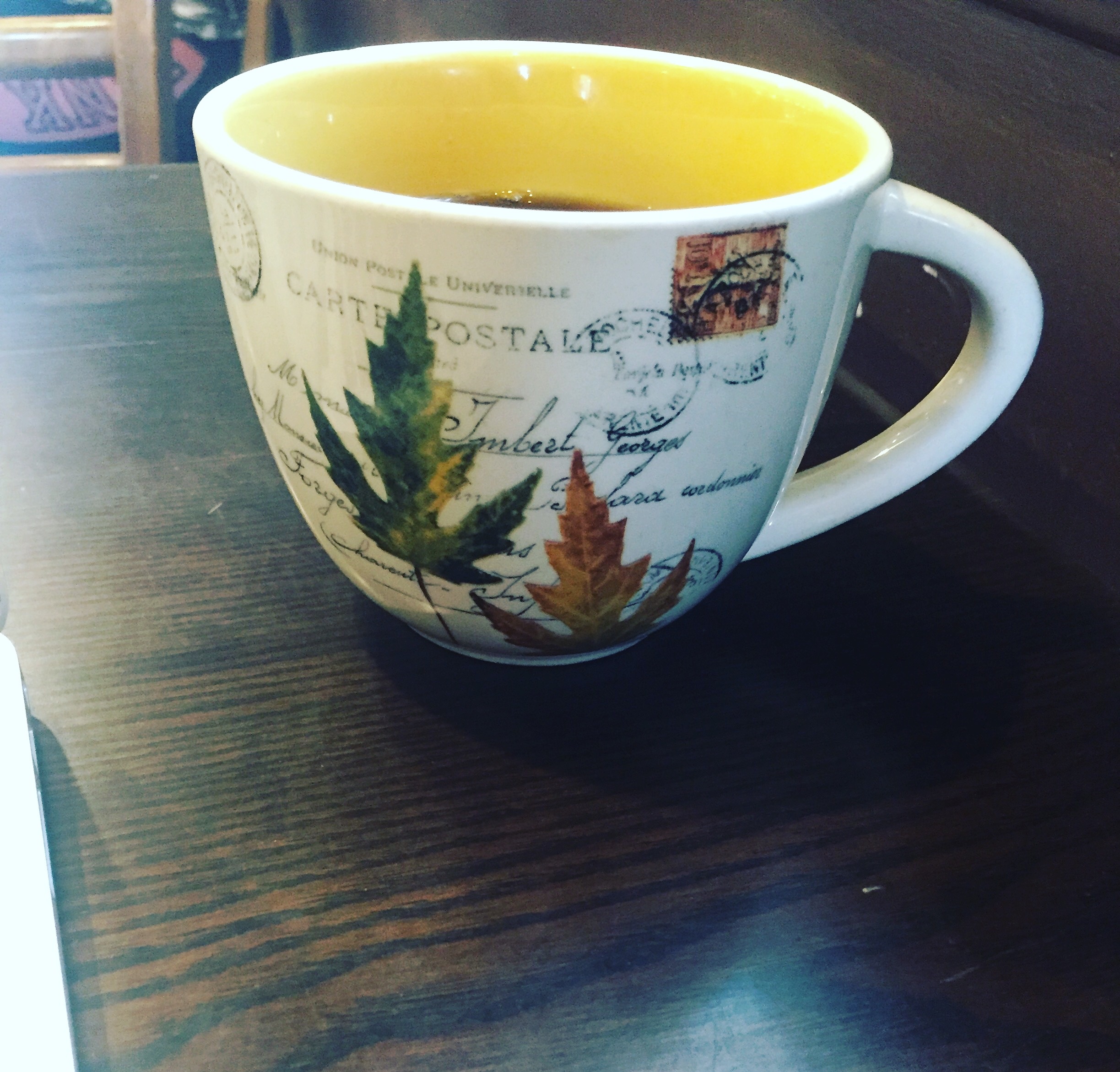
coffee
From my favorite cafe. Also: love their mugs


 My point is, there's always going to be something out of our control, as much as I dislike this (I need to work on my letting go). But those days in which I ran my own company fully, I had control over so many important factors: the company as a whole - the direction it went (or ideally went), the mission and vision, the goals, the values it all embodied. I had control of the marketing, both in print and online - not only the content, but what I chose to do/not. The target market. Not to mention that, client emergencies aside, I got to make the schedule. I chose when to start and end work. If I needed a personal or wellness or sick day, I took it. If I had to make it up later by working longer other days, I did. I made those decisions.  For someone with chronic illness, that's particularly important. And possibly, most importantly, I felt like I was working toward something and for something. I had goals for my company, and for my life involving it.  I felt like a made a difference - not necessarily in the world at large, but to my clients. I felt important to my little piece of life. Because without me, the business wouldn't run, and the clients wouldn't get their travel planned by my company.

So I sat there remembering this feeling. Being reminded of what it felt like to really feel connected to my purpose. I helped people experience the world. They explored new cultures and traditions. They had their first experience zip lining or swimming with dolphins or hiking a mountain they always hoped to hike.  They had exciting honeymoons and destination weddings. They had family reunion trips.  I had clients who came to me never having owned a passport and, after their first trip overseas, decided to take one every year.

And when I think about being able to help others, to Spread Hope to others, and to potentially be able to combine my love of helping people with my love of helping people travel (and naturally, traveling myself), I think about how amazing that would be.  To get back to that feeling of purpose, that I'm doing what I'm supposed to be. That ability to feel happiness at how I'm spending my days. To feel like I'm making a difference in my little corner of the world, both to others and to myself.  And thinking about it, while a bit sad at not being there, makes me hopeful. I begin gathering ideas, almost involuntarily (though certainly welcomed). I don't try to, they just fly into my head. I get inspired and motivated.

Now if I could only stop the doubt from creeping in. The doubt that says that, once again, this wouldn't work well enough. That something - the economy, life, etc - would throw me off and I wouldn't be able to push through it to ultimately be successful. The doubt that says it's too risky, that I'd be being rash and careless. The doubt that says others would be disappointed me, would doubt me themselves.

And if I could only get some help. Not financially, but in the form of support. If I had friends that would be willing to help me create and run projects for Spread Hope. Or who would help me by participating - whether it's hashtagging their Instagram photos for a photo campaign, or volunteering with a project I organize, or just sitting and helping me brainstorm ideas. And I know it's a big ask. I know everyone's time is so valuable. But we all need help sometimes, and I'm really terrible at asking for it. I'm strong and I want to be able to do it all on my own. And often I think it's too forward to say, "Hey I want to do xyz will you take time out of your already busy schedule to help?", despite the fact that if someone came to me and said something similar, I'd probably be super excited (assuming it wasn't some sort of selling). Or I always think, "nobody will say yes. Or they'll 'like' the status but not volunteer", so what's the point.

But I need to get over that fear. I need to reach out and ask for help. I may not get tons of help by doing so, but I certainly won't if I don't.  So I'm starting 2018 with some opportunities, and call outs, for help with Spread Hope Project... projects. So if you have the urge/want to be supportive, please give the Spread Hope Project page a follow at the link above so that you hear about these when I roll them out. You'll also find SHP social media links on there (hint). It would truly mean so much. And of course, if you're interested in helping, I'm all ears!

And on this shortest day of the year, I hope it helps to remember that it literally only gets brighter from here - and I'll do the same.

Happy Solstice, and Happy Holidays!

Monday, December 18, 2017

The Most Important Thing I've Done Is Survived; and Sometimes, I Even Live

When you battle depression, you know that often the best you can do is just get through the day. You may not be breaking any records, or busting through your to do list, or even showering. Some days, getting through the day is what matters most. If you lay your head down at night in order to be here tomorrow, you've accomplished the most important thing you can - you've survived.

For those who don't battle depression or chronic illness, I think this is a difficult concept to truly understand. For them, surviving is second nature. They don't have to think about it, wonder if it'll happen again tomorrow.  They don't go to bed at night with the sole accomplishment of still being here. Instead, they look at the things they haven't accomplished: the house needs to be cleaned, they need groceries, they have to do this or that chore or task. And don't get me wrong, my anxiety rails through all of that too. Repeatedly. But the thing is, if I weren't here, if I hadn't made it, it wouldn't matter one bit how clean or not the house was or how full the fridge was.

And so, I admit, that sometimes my priorities seem a little "messed up" to the observer. The house desperately needs to be cleaned and I'm planning a hike or a day trip or a drive to the beach or something of a similar fashion. Or I'm relaxing, listening to the rain or enjoying the sunshine on my face. Sometimes, I go for a drive simply to enjoy the warmth of the sun (streaming through my new panoramic sunroof!!), the open air, and the musc. And understandably, people probably feel, If you're going to be out on a drive, could you maybe stop and pick up xyz while you're at it, because you're running out?! And yes, I probably should. I probably need bread or beans or a replacement light bulb or something from CVS or whatever it is. And I may stop and pick it up (ok, usually just the CVS, big stores give me anxiety). But you know what I really need? I need to have these happy, sun and fresh air filled moments  to pull me through when I cycle back down. If not, I'm spending all of the times I actually feel ok filling obligations, only to slip back into depression without being able to remember what in life there is to truly enjoy.

And so I perhaps do not make a very good adult. I do not see the point of spending the majority of my time doing the mundane things that will never be my legacy. I'm not saying I'll live in a pigsty or starve, but I just simply don't get the need to have this all perfectly done, all the time. And maybe there's a compromise. Maybe I can run into Whole Foods once a week, spend 30 minutes tops  (I can honestly get all my shopping done in this time), and have had healthy meals all week. And when I am running out of TP, I can stop at CVS for 10 minutes max. No need fora full day dedicated to these things.

I realize this is frustrating for people in my life. I wish I was content to do the everyday adult life things. I really do. It would be so much easier on those around me. Not to mention I'd have a full fridge on a regular basis, and a cleaner house. I know it seems irresponsible. And I'm trying to find a balance, I really am. I'm not sure where that lies.

Maybe it's just me. And maybe it's the fact that I feel my time to actually feel alive is limited, since illness hits me so often. But I just don't think I'm going to lie on my deathbed wishing I'd done more chores. I do think, though, that if I stick to those "have to"s, that one day I'll look back and think, What did I do with my life? And moments of life can be so precious, that I can't imagine why I'd want to live that way.

Me in Ronda, Spain, after a sunrise hike. The ultimate in enjoying a good day!

Friday, December 8, 2017

Grappling With Questions

I haven't blogged in a month-ish. For me, that's a long time. Part of it is trying to keep several blogs going (this and Spread Hope Project), along with my business, my part time job, and my organizational work. There's also Thanksgiving and then the week and a half I spent in Spain, the latter of which I just finished. Plus I've spent the past few months continually exhausted, and when my brain is so drained, it's tough to find writing inspiration. Or, you know, think of intelligent- sounding sentences.

But it's not just that. I've been battling a lot of confusion within myself. I feel like I'm at a turning point in my life, except I don't know exactly what that point is. I know that I have to do something. There's a lot about my life that feels like it doesn't quite fit me right, but I can't quite figure out why. It's like wearing clothes that technically are your size, but there's something about them that just feels off.

When I dig deep down, there is one glaring question that I am struggling to answer:  What am I doing? Sure, the answer sounds obvious. I manage to fill my days well enough. I have work and my business and my blogs and my organizations, and of course, my loved ones and friends - the most important part of it all. But what am I doing that will make a lasting, positive impact - externally, and internally.

Taking out loved ones and friends, because hopefully I have a lasting, positive impact on their lives, I ask myself continually, "What is my point?" And this is not to downgrade loved ones. But as I'm not a mother, or a caretaker, or anything like that, these relationships aren't the primary part of my days, despite being the most important overall pieces of my life. When my family and friends and husband go off to work for the day, there's a whole lot of time in between that I want to fill with purpose. So what am I doing with it? What am I working towards? What do I ultimately want my life (outside of loved ones) to be about?

That's where I'm struggling. I feel like I'm grasping pieces here and there, but having a difficult time pulling them together. Inherent lack of self-esteem and confidence in myself doesn't help, because I continually question my ability to successfully do anything that I may come up with. It's like I can't manage to see myself as succeeding, as being successful, as getting where I want to go. It feels like I'm playing dress up (I'm really into clothes analogies today, it seems).

Thinking back, I didn't used to be like this. In gymnastics all through my youth, I always went for the biggest and toughest routines. I often fell on my head and my ass (and on beam, other parts that shall remain nameless but every gymnast understands). But I went for them. I literally got points for effort, and those points added up to me getting to one of the highest levels I could in the sport. After college, I went out and interviewed confidently for jobs. I never thought I wouldn't get them, and I had several offers right away. There wasn't doubt and fear and anxiety. When I started my travel business, I was sure, confident, excited. I didn't question "what if it doesn't work?".  I worked on it day and night, believing that it would. (The economy tried to thwart me, but that's a whole different story).

In fairness, part of that might have been lack of medication (i.e. hypomania), but part of that was simply believing in myself. Part of that was life not having beaten me down as much, and me not letting those times it did shape my image of myself. So how do I get that back? How do I take those big steps, those leaps of faith, while feeling confident, and not let that confidence be shot down when I hit a hurdle, or even numerous hurdles? How do I step back and look at the big picture without allowing these fears and anxieties take over, so that I can see the overall path ahead of me? Because right now, it feels like I'm trudging through mud, in a complete haze, unsure of even the slightest step, let alone which path to take.

I know this post is kind of rambling, but I feel that's how my brain is at the moment, so it fits. My thoughts and ideas are being pulled in 50 directions, none of them seeming to be exactly right, yet each of them seeming to be a piece of the puzzle.

I'll take your suggestions and ideas. I'd rather not take your rah rahs or cliches or inspirational quotes that really don't help me at the moment. But I'm open to your honest thoughts. And I'm open to your messaging/emailing/texting me if you'd rather not put them in comments.

Until then, thanks for listening to my rambles! 

Thursday, November 9, 2017

When is Enough, Enough?

There often comes a point in life when you feel you must say "enough's enough". I don't entirely get the etymology of that phrase, but anyway, a phrase it is. The point being, at what point do the costs outweigh the benefits. In some cases, this is literal. In others, it's figurative. When you're living with a chronic illness, you may well deal with both.

Those of us that have illness(es) every day of our lives are used to living, what we call, low on spoons. There aren't a lot of days where we feel we're 100 percent ready and ready for anything life throws at us (caveat: some people have told me they feel this way in a manic episode. I only feel jittery and agitated in mine, so I don't experience this). And generally, we persevere. We are spouses, parents, employees, bosses. We volunteer or we participate in community activities. We try to live our daily lives as "normally", for lack of a better word, as we can. We may need more naps or to go to bed earlier or to take a break once in awhile, but we keep plugging along.

But at what point do you no longer do that? At what point do you say, "my health, my sanity (in my case) has to come first"? At what point do you finally decide that something's has to change. At what point do you say, "This is going to be a really difficult change, and it may even affect those I love, but so will losing my sanity, and I'm headed straight down that path"? And how do you do that? How do you tell those that are depending on you, often in numerous capacities, that you have to chose your sanity? How do you explain that it may seem like a drastic decision, like a short term solution, but that losing your mind, which you are actually close to doing, will be a much longer term problem? How do you get that courage, that conviction?

It's ideal, of course, if others are the ones to suggest the changes. If your loved ones say, "Listen I know you love volunteering at the xyz or participating in the abc, but it's having a terrible effect on your health. Maybe you should take a break." Or if they say, "I know you're trying to be everything to everyone, but let me take over xyz for a little bit." It may even be them supporting a career change, or you taking a chance and choosing to go after a dream. Of course, some are bigger decisions than others. Suggesting you leave the PTA is not the same as suggesting you reinvent your career in the middle of your life. But my point is, it's ideal if they come to you. Because it takes away a little of the guilt. And yes, there shouldn't be guilt for putting one's health and sanity first. But at least for me, there's always this nagging, "What if I just wasn't trying hard enough?" What's ironic is, I would never feel this way about someone else. I'd be 100 percent behind them making whatever changes they need to. I'd understand exactly how they feel, and I'd be the first one to tell them that if they don't have their health and sanity, that they can't be there to help others, so in the long term, it's best for everyone. But when it comes to myself, I'm always managing to convince myself that I can't let anyone down, or put anything at risk. I always manage to convince myself that I just have to get through it, because I'm failing otherwise. We are, I think, our own worst critics. And so someone else being on your team, looking at things from the perspective of your health and sanity instead of the perspective of "how things normally go" or "the most logical solution", is one of hte most amazing feelings one can experience. And for it to be their idea, for them to be behind it lessen the self-criticism, is amazing.

But sometimes, that isn't the case. Sometimes it feels that nobody truly understands what is going on inside your head. You look ok. You're holding it together. You had a good day/week, and that makes them think it's not that bad. And it's understandable, I suppose. They see you've gotten through everything else. They think it's a kneejerk reaction, or that you're so emotional that you're not thinking it through. They don't understand the battle raging in your head. The battle that you're losing more quickly each day. So what do you do? When, and how, do you say, "Enough is enough"?  Have you done this? I would love to hear your stories. 

Wednesday, May 24, 2017

On Those Days When You Just Want To Run Away

I know the feeling. There are days that you wake up and you think, "I just can't do this." It's not a specific task or job or anything - it's just this. All of this. There often isn't a specific "reason" per se. It's not that you're in so much more pain than the day before. It's not that anything traumatic has happened. It's just that life is looming. Closing in on you. Sometimes, it's a last straw. One more thing goes wrong, and you just. can't. take it.

When this happens, there seems only one plausibility: run. You think that if you could just up and leave, start a new life, maybe you could outrun illness. You picture this new life in which you're in some new town or foreign city, where you've somehow managed to make work everything that you can't now. In this new life, you're not socially anxious - you can actually talk to people and make friends. In this new life, you can actually handle stressful situations without melting down and crying. In this new life, you have skills and talents that actually make you feel like you have something to offer. And you have confidence that make you feel "worth it", able, capable. And you actually are. You feel that if you could just start fresh, you'd be OK. You'd be able to get up in the morning without dread. You wouldn't feel so dark and lonely and alone. You wouldn't be so anxious, so fearful.

Now let me clarify, this generally has nothing to do with specifics. It's not that you're unhappy with your friends or family or partner. It's not that you dislike your job. It's not that you're ungrateful and think you have it so bad, or lack perspective. It's just that you physically, mentally, emotionally need to get the hell out of dodge, and you feel like you'll break if you don't.

I'm not going to sit here and give you platitudes. You'll get no "but there are starving children in Africa" guilt from me. Because that's not the issue. You know it's not, and I know it's not. The issue is that you feel like you just don't belong in your life.  Those closest to me will often hear me say, in my darkest moments, how I feel that I don't belong in this world. Like I was born in the wrong century in the wrong place, and that no matter how far I wander, I'll never feel at home. Because even if I get to the right place, wherever that is, I'll still be in the wrong century. It feels like I'm hollow, unfulfilled. Like until I find the "right" place and time I can't understand why I'm here. It feels lonely and isolating, and worst of all, I blame myself for it. It feels that if I can just run far enough, maybe I can outrun that self-blame. But that no amount of "you do so much good" or other similar words will help. The only words that could possibly help would be "wherever you run to, I'm going with you" (by someone close - otherwise that's called a stalker). Because at least I know I wouldn't be alone.

I wish I had a solution to offer. I don't. But I can tell you that I know what it's like. And if it helps you to vent to me, to tell me all about where you'd run to and what you'd do and what you dream of your life being, then I'm happy to listen. Imagination can offer hope, and sometimes, it's enough hope to lessen the need to run away.  Or perhaps knowing that someone else understands helps you to feel less alone. Less estranged from everyday life, from the world as a whole. The only other thing that I can suggest is to create a system of "mini breaks". Perhaps it's that you have a notebook, or a bulletin board, or a jar in which you toss written suggestions of those ways to give yourself a mini break without actually having to run away. Maybe it's going for an actual run. Maybe it's taking a drive, or a day trip out of the immediate area. Maybe it's doing something fun that you don't often do - something that reminds you of your childhood, or a happier time. Perhaps it's simply writing out your feelings, or daydreaming with a friend. Try to think of those things that could take the edge off the need to run away. They may not solve it all together, but they may give temporary reprieve. Hopefully, the need will eventually pass. I realize that doesn't offer a ton of hope, but it is, unfortunately, the best I have. And always, know that you aren't alone.


Wednesday, May 10, 2017

Today, I Empathized With A Mouse

Some background:  My fiance and I (and our dog) are currently staying with my parents while our condo is under kitchen and bathroom renovation (complete tear down and rebuild). Over the past few weeks, we've noticed that something other than ourselves and our dog has been munching on the food in their pantry. Now if you know anything about me, you know I'm a strict vegetarian that literally can't hurt a fly. But I also understand that my parents don't want mice traipsing, among other things, around in their food.

My parents, being the good people they are and knowing that I can't stand to see a creature harmed, put out sticky paper so that they don't have to kill the mouse, but can manage to relocate it outside. This morning, a mouse, being unknowingly obliging, got his or her foot stuck on the sticky paper. My parents shielded me from it by telling me to stay downstairs, so that I didn't see the mouse struggling at all, while they brought it outside, extricated it's foot from the paper, and set it free in what seemed as safe a spot as they could. And I love my parents for doing the most humane thing possible outside of just letting a mouse wander through and poop in their food, potentially spreading any disease that goes along with this.  But still, I broke down. 

It wasn't really about the mouse. Yes, I was sad for it. Being the highly sensitive person and empath that I am, I hated the idea of a living creature experiencing any pain or discomfort. But more than that, I empathized. I pictured that poor mouse stuck, having no idea why, with no clue of what to do, trying in vain to move and run but being trapped - not in an actual trap, but by its inability to go anywhere, struggling for the little movement it had managed to obtain, all the time confused about what had happened to it. And in that moment, I felt just like that mouse. 

Lately, that's exactly how I feel. Depression, anxiety, and mood cycling can stop you in your tracks. There are days, weeks, months where you can try as hard as humanly possible and you can't break out of it. No matter how much wonderful you have in your life, no matter how grateful you are for the support you have and the good things that come your way, it doesn't matter. The sadness takes over, the anxiety sets in, the cycles continue despite every attempt to stop them. Your life seems to halt, even though the world goes on without your feeling able to participate in it, at least not as you wish you could. You feel that you're going nowhere, that you have no hope, that you aren't able or capable. It feels as if everyone else is, and somehow you just fail - like someone else could do exactly what you do and they'd be successful and moving forward, but when you do, there's nothing. Some days, you just don't feel like you have the energy to even try to fight it. Like you're that mouse, and you eventually realize that all your struggling to move just takes precious energy that you're already lacking. 

And on top of all of this, unlike the mouse, you often must try to pretend it's not happening. It's not acceptable to spend your days curled in the corner of your office crying, unable to interact with coworkers or clients. Or maybe there are those who don't understand, and when around them you feel it's easier to just put on the mask. Or perhaps you're simply tired of everyone thinking of you as "that person who's so depressed and anxious that they can't handle anything." Do you know how frustrating it is when people assume you're anxious even when you're joking and happy? But they're so used to you being worried about everything that even what sounds like a joke to you comes off to them as seriously upset. Even in your happy moments, when they come, you have to deal with the results of depression and anxiety. And so you just smile and nod and say you're OK, until those days when you can't. Then, you do those things you absolutely feel you must, and then quietly retreat, cocooning in yourself in an attempt to heal through isolation. 

I realize that this is a lot to get from a mouse with it's foot on some sticky paper. And there may be some ever-optimistic people who say "But look, the mouse got out free! Your parents made sure it was safe!" And that did make me happy. It managed to bring a bright spot into an otherwise incredibly tough morning. But the difference between me and the mouse is, there's nobody who can ensure I will be Ok. They can help me along the way. They can support me. They can be there for me on the days that I'm not, and they can try to lift me back up. And perhaps nobody can ensure that the mouse is OK either - nobody knows what happens to it after it ends up in the field, and that's life for all of us. But in that moment, we could. We could take care of that little mouse and set him or her free, and hopefully he or she felt like it had a new chance at life. I'm sure there are people ready with platitudes to say things like "Every day you wake up is a new day and a new chance at life". But that's not true, not really. Because I still wake up as depressed or as anxious, or I'm still cycling badly. There's nothing new about it, and that's the trouble. I'm stuck in that trap. Nobody can magically set me free and say "Go, run, live! You're saved!" And while a week from now that mouse may have no memory of the sticky paper on which it struggled, there's not a day that goes by that I can forget the illnesses I battle, even if they're just kind of sitting there quietly on the periphery.  And so many days I wish someone could just say "You are too precious to hurt, even though you don't really belong here. So we're going to save you. And once again you'll be where you belong, running free." 

Tuesday, May 2, 2017

Why Mental Health Month Is So Important

Yesterday was May 1, so I'm a bit tardy. My days have been incredibly long, and I haven't had a ton of time for blogging, but I'm trying to prioritize it once again. May is Mental Health Month, and that's important, and so it's pushing me to pick up my pen and paper open up my blog page, and start raising my virtual voice.

Why is Mental Health Month so critical? Quite simply, because we shouldn't need it. We shouldn't need a month that tells people it's OK to talk about mental health. We shouldn't need a month to work on eliminating stigma. We shouldn't need statistics that tell us how prevalent mental health conditions are, or how many people take their lives each year - each day even -when people try to deny that mental health is a priority. We shouldn't need to explain at length, ad nauseam, why mental health is no different than physical health when it comes to how we should be treated, both as people, and actually medically treated. We shouldn't have to be fighting to take a sick day for our depression, when nobody would bat an eye at us taking a sick day for the flu. We shouldn't have to explain that we can't just think happy thoughts or smile more or calm down or look on the bright side or be more grateful. We sure as hell don't need to be told to just pray about it and we'll be "saved" - we need therapy, medication, understanding, concern, people taking us seriously, not an exorcism.  But we do have to do this. All of this. Sometimes on a daily basis.

We have to listen to "well everyone gets depressed", or "we all get anxiety", by people who think that depression and anxiety really mean being "down in the dumps" or simply stressed.  We have to listen to people say things like "omg she keeps changing her mind, it's like she's bipolar" (yes, I just used "omg" in a post, because to me, that's the least ridiculous part of that statement). We have to hear phrases like "I'm so OCD today; I think my ADD is acting up today (when they have neither); I'm so depressed I have nothing to wear to this party." While we sit there not wanting to get out of bed, not feeling like there's a point to our lives, like people would be better off if we just never existed. I don't have OCD or ADD, so I won't pretend to know what it's like to have those, and to hear these comments. It must be frustrating as hell.

We're constantly bombarded with the media creating monsters out of illnesses, touting how people with a mental health condition are violent, oblivious of the fact that people with a mental health condition are 10 times more like to be victims of a crime than perpetrators. But there's no media that will stand up and say that, so we have to listen to it. And then we have to listen to people - often people we know, sometimes even those we are close to- believe it and worse, repeat it.

This is why we need Mental Health Month. And we will need mental health advocacy not just during this month but every single day, year round until this type of stigma goes away. Thank you for listening to my rant/vent, I am much obliged. Now please, get out there with me and help me fight this stigma. 

Wednesday, December 7, 2016

Mental Health Pet Peeves

In the mental health community, we face a lot of stigma. Some of it is overt. People calling us crazy or mental or insane. People saying we're dangerous, violent. These people, while they frustrate the hell out of me, are sometimes easier for me to deal with. I pull out statistics about how those with mental health conditions are ten times more likely to be victims of a violent crime than perpetrators. I tell people how I run a business and work a part time job, have recently written a novel in my "spare time", and have served on numerous boards of directors, to name a few accomplishments. This tends to make people realize perhaps I'm not as "crazy" as they would like to think. Or they do, and I tell them where to shove and move along because they've decided to be closed minded and nothing I can say will change that, so they aren't worth my time. But the people that don't get what they're doing are the ones who really get to me. Because that is how stigma and ignorance disguises itself in a pretty little helpful bow, and continues to be perpetuated. Here are a few of my top mental health pet peeves.
  •  "Just pray about it." Ok, first off, I've been black listed by the Catholic church for living in sin for the last umteen years (divorced, not annulled,etc etc) and quite frankly it pisses me off that I'm counted as much of a sinner as a murderer or a rapist simply because I left an unhealthy relationship. But all of this is besides the point BECAUSE MY ILLNESS IS NOT A SIN OR A PENANCE! I jokingly call it the gremlin in my head, but that's a joke. Because it's so ridiculous that a separate being would be actually possessing my brain that I can joke about it. Praying, if I were religious, might calm me. It might give me some sort of comfort. If I were religious. Which I am not. Now, to be clear, if you are religious and want to pray that I'm feeling better, by all means, go ahead. It's how you feel you can help, and I truly appreciate that you want to help in some way. I'm not telling you not to pray or believe, and I appreciate you doing what you can to help. Who knows, maybe it'll work and I'll become a believer again.  But please, don't tell me the only thing that I can do to help is pray. I respect that it's your thing, but it's not my thing. And I'm not looking for a miracle. 
  • You're a pawn of the pharmaceutical/doctor industry. They're making you sicker so you buy the drugs and they get rich.  Ok first of all, did you witness the first 30 years of my life? Did you watch me at 2 years old in hypomanic episodes begging my parents "make it stop, make it stop." But I'm just fine off my meds?  How exactly do you, who is not in my head or my body, know that?  Let me set you straight: my meds, and the meds of so many others, are life-saving. When you have a potentially fatal cancer and choose not to take medication, please, come to me and show me how you've magically healed on your own. Then we can talk. 
  • Oh I don't need medication, I've cured myself with these herbal supplements and exercise. Well hoody hoo for you. You are not me. You're not inside my brain. I have a bachelors in kineseology, worked in corporate fitness for five years, and am a certified personal trainer and fitness instructor. If exercise could cure me, I think I'd be fine and dandy by now. I'm honestly glad that works for you. You're lucky. Me, not so much. It does help me at times, but it doesn't cure me. Nothing does. I have a chronic illness that currently has no cure. 
  • Just relax/chill out/calm down (during anxiety/hypomania). *%&$&*$%&#$%*$% You. If I could, I would. And here's a tip: never, in the history of telling people to calm down, has telling someone to calm down actually made them do so. In fact, it does the reverse. 
  • Just focus on the positive more. Be more grateful.  I'm not ungrateful. I know I have "no reason" (as you put it) to feel so awful, worthless, terrible, hopeless. I know there are starving children in Africa and that so many people are more sick, or have it worse. But I do, actually, have a reason. It's called a medical illness that screws with my brain. And now, thanks to you, I simply feel guilty about having this illness, and more like a giant piece of shit than I already felt. 
  • Why are you depressed? You have a good life. If I asked you why you couldn't just stop having cancer because you have a good life and *should* be healthy, I'd look like the biggest asshat on the planet. When you ask this, so do you. 
  • I  avoid people who are emotional/dramatic. Every time I see this in anyone's status/profile/etc I run like the wind. Because this makes me feel like I can't be myself if I'm having an overly emotional day, and like it's my fault if I am. Like it's not an illness that makes me this emotional but a choice. It makes me feel like a burden. And I don't want to be a burden to anyone. I'd rather be alone. 
  • Happiness is a choice. Ah, well, no shit?! If only I'd known! All this time, I've been suffering from a lifelong illness when I could have just decided not to be depressed! I hope you can sense the sarcasm. If happiness was a choice, approximately 16 million Americans would not be living with Major Depressive Disorder (source here). Trust me, we don't want to be depressed, and we certainly never chose this on purpose. 
  • You can't control what happens to you but you can control your reactions to it. Clarification: in a perfect world, I agree. But in a perfect world, 16 million Americans would battle major depression either. By nature of my disorder, my brain makes it increasingly difficult to control my reactions, and sometimes nearly impossible. If it helps make this a bit more clear, my meds are actually used primarily for seizures. Basically, I'm having a seizure- like reaction in my brain that manifests itself emotionally/mentally instead of physically. And if you've ever witnessed someone having a seizure, you understand the lack of control. If I could not have an anxiety attack or panic attack in public, I would.  Because nobody likes being stared at and steered clear of in public. Nobody likes collapsing in a pile of tears in the middle of a crowd. And if I could not sink into a depression, I would. Trust me, even through a depression, I'm trying to keep to react as best as possible. I'm trying not to let it drag me under into an abyss of nothingness. I don't always win. Please believe me, if I can't control it, I really can't.
Fellow mental health battlers, have more? I'm sure there are plenty. I try to laugh at them, to brush these things off. It helps keep me from isolating myself, feeling like nobody understands me. So I joke and use colorful language to make them lighter. But honestly, these things aren't funny. They're annoying at best, and ignorant and stigmatizing at worst. 


Monday, November 14, 2016

Case of the Mondays

HAWMC Day 14:  Case of the Mondays. Write about something that gets you down, burns you out, or makes you sad.  Purge it in a blog post. Turn it around at the end and tell Tuesday why you’re ready for it.


I feel like this is kind of a trick question for mood cyclers. Because naturally, the answer is depression. The definition of the condition is pretty much that it makes you feel all of these things, just on a much, much larger scale. And quite frankly, I'm never really ready for it. But that would be kind of a cop out, and the shortest post ever. So I'll make my answer a little more robust. 

What gets me really burns me out is the wide gap because my goals and dreams, and feeling unable to get there because of depression and anxiety. For someone who battles these, I'm a dreamer. I get all of these ideas about how I want to shape my career, my life, my advocacy work. I create plans (albeit not always full, in depth business plan type of plans, but still plans). I brain storm and make lists, actions items. I recently bought a Freedom Journal to help me move towards my dreams step by step - to make it feel more manageable. And I was super gung ho on it, doing really well. Until I had a couple of bad days. Then, I not only fell off the wagon, but I landed in a different county. 

Because my depression and anxiety seriously f-'s up my confidence and self esteem, one small snag in the plan totally destroys it, and me. If I try to take the steps I have outlined and get no traction, I go into full "I can't ever do this" mode, time and again. Part of it, I think, is that I'm honest with myself in knowing my weaknesses, and when I'm faced with a task that involves these, one disappointment is enough to derail me. Like I'll create a fundraising event, or I'll reach out about an idea that I want to move forward, and I ask my friends to participate. And I get one or two half-hearted maybes. The rest either "like" it and never take action, or don't even acknowledge it (friends "liking" and moving right along, by the way - HUGE pet peeve. That could be a whole 'what burns you out' post in and of itself). This happens, and I give up. 

If I'm honest, though, I think it stems from a bigger issue, that gets me down even more. That issue is figuring out exactly what the hell I want to do with my life. I have a general gist, but my brain likes to tell me I can't do that, or it won't work out, or for some reason it's not acceptable/feasible/etc. So I try to move towards ideas that touch on that concept, but seem more acceptable/feasible/etc. But my heart isn't fully in them. Or maybe it could be eventually, but right now, it's not my passion. And I'm a person that needs to be 150% all in or out. I don't do well with doing things that aren't my passion (not counting "life things" like chores and grocery shopping, though I'm not good at those either). So I guess, what's really getting me down is not knowing exactly what I want to do with my life, and feeling alone in both that decision and in making it happen when I do decide. I am an introvert that likes my alone time, and I definitely like to do things my way (i.e. Maya and being told what to do/being controlled by other circumstances or people don't mix well), but I also don't love doing it all on my own. I know the pieces that are toughest for me, and I would like help with those. Or just someone to have my back, to help when I'm burnt out or my conditions make me not unable to move or whatever it is. Or another brain to give ideas when I get stuck and unmotivated. Not just to tell me what to do or give me tips (or cliches, god no cliches), but to actually participate. Just knowing I don't have to do it ALL alone would be so helpful. 

And so I've rambled. But we all know not to tell someone with thought patterns that look like a bowl of spaghetti to purge if you mind them rambling. I do feel a little better putting it out there, though. So thank you for listening. Until tomorrow, HAWMCers. 

Tuesday, November 1, 2016

Why Do I Blog About My Illness?

Happy November! November, for those who don't know, is National Novel Writing Month (NaNoWriMo), which every year I say I'm going to participate in and every year I sadly do not. But lucky for me, there's another writing challenge this month that I'm much more likely to stick to, at least on a somewhat regular basis, and that is the Health Activists Writers Month Challenge (HAWMC), hosted by WEGO Health.  I'll be blogging daily based on daily prompts, so posts will probably be nice and random - just like I like them.

Day 1:  Why do you blog? 

For nearly the first almost three decades of my life, I thought that I was allergic to red food dye. That was my diagnosis, at the age of two, when I started having "episodes".  The doctor told my parents that the red food dye in the cereal I'd eaten (I want to say Captain Crunch but I may be wrong here) made me "hyper", and I was to avoid red food dye. I spent the next 28 years doing just that - admittedly, not a tough feat, unless you count the cherries in Old Fashioneds and Manhattans. But though the "episodes" calmed down for a long stretch of time, in part due to intense gymnastics training that helped with a lot of the extra "energy", in part writing them off as just being an aspect of my general personality, they didn't stop. They started back noticeably when I was in my early twenties and got increasingly worse, to the point that I'd have someone (my then-husband) hold my arms and legs so I could punch and kick the air to release all of the pent up "energy", for lack of a better word. In between these episodes, went through periods of feeling lost to myself, which grew in frequency. Finally, weeks before my thirtieth birthday, I was admitted to the ER with what I thought were horrendous panic attacks that wouldn't go away. Long story short, I was hospitalized, and upon going back to my therapist afterwards, was diagnosed with rapid cycling cyclothymia, a rare mood cycling disorder.  It was this that had actually sent me to the ER.

I had never heard of cyclothymia, and as it turns out, neither have a lot of people - even medical professionals. It's that rare - something like 0.04% of the population is diagnosed. I noticed that there was very little information accessible to the general public about my condition, yet there seems to be a massive amount of stigma. I realized that people don't have to know anything about your condition in order to begin stigmatizing, especially when it comes to mental health. To so many people, it's all the same. In fact, it's the lack of information, and the education, that feeds so much stigma. And so I set out to do my part in righting that. To tell my story, so that others have first hand accounts of what my illness is like, and to offer support to those who also battle, or feel that they may.

What do I want people to know about my condition?

  • It is not bipolar disorder. Often I have to choose that from the little drop-down box of illnesses on online forms with health history, but it is a distinct condition of its own, that shares many similarities with Bipolar Disorder. 
  • I cycle between hypomania and depressive episodes, sometimes as often as several times a day. While many people battle more depression, I battle more hypomania - which is not as fun as it sounds. Hypomania, I often tell people, feels like drinking an entire pot of coffee at once on an empty stomach and then trying to go about your average daily routine. You feel jittery, irritated, unable to focus or concentrate. It's in fact very frustrating. 
  • I'm not always cycling. Sometimes I'm neither hypomanic or depressed - many times, in fact. Nor do I cycle mid-sentence, like the media would have you believe. I slowly begin to feel the warning signs, which generally only I can feel, and it begins to gradually transition. Again, using the coffee example, the first cup is probably ok, the second cup may make you a bit extra energized, by the time you've finished the pot, the effects are full-fledged. 
  • I battle anxiety because of my condition. I've developed social anxiety, phone anxiety. This is not uncommon. 
  • I can do "normal" things and have a "normal" life. I run my own business, work part time at a conference center, own a home and a dog, am in a committed relationship, and have been on several volunteer board of directors. I've also traveled to six continents and over 40 countries. 
  • Not everything I do or say or react to is because of my condition. Sometimes, I'm happy or sad or emotional or annoyed or angry at something just as anyone else would be. 
  • My condition does not make me weak. Just because I'm depressed or crying or feeling worthless or hopeless does not make me weak. I, and others with similar conditions, have to be incredibly strong just to get through some days. 
  • I will always have this illness. It is genetic.  I was born with it, and I will have it for the rest of my life. I can't "get over it".  It just gets better or worse. I've accepted this. Please do so as well and stop waiting for me to "snap out of it." 
  • I'm not lazy or over-reactive or not trying to hard or dramatic. I can't just relax or calm down. I can't just think positive thoughts or smile or be grateful. 
  • Sometimes the best thing I can do is rest. I need that time mentally and physically. Sleep is critical for mood cycling, and my condition is very draining. Doing every day tasks can feel insurmountable at times. 

In addition to Cyclothymia, I also battle Chronic Fatigue Syndrome, "severe" (doctor description) IBS, vertigo, and various forms of frequent migraines. While I don't discuss these often, I do occassionally post about them, especially as they intertwine with my mental health. 


Monday, October 17, 2016

I'm Slowing Down On Social Media for the Sake of My Mental Health

I've been on a self-imposed personal Facebook ban for several weeks now. I do social media for my business, my Conference Center, and my mental health advocacy, or I'd be on a ban altogether. I'm not going to lie - when I go on for these reasons, I usually sneak in a "happy birthday" to those I'm close to, or occasionally like a cute picture of a dog if I see it without scrolling. But I'm trying very hard not to scroll, nor am I posting, with the exception of one picture collage of Grace.  Twitter is slightly better, and it moves past quickly, so I rarely have to look at something again and again and again.  Instagram has lots of pictures of puppies and inspiring travel destinations, and snapchat is mostly one or two friends using funny filters to make me laugh, so that one's totally fine.

Here's the thing that I want to be clear on: I am not determining my friending or following or unfriending or unfollowing on my political views, which I will not discuss here unless they directly relate to mental health legislation or something of the like. It's the views. In general. I don't care if you are saying you're going to vote for ME for president (please don't, I'm an introvert who gets anxiety when people make eye contact with me, and I look bad on camera). I'm usually one for a good political discussion between people who can agree to disagree at the end of the day and still respect each other as people, even when their views differ. But what 90 percent of people on Facebook are doing is immature mud slinging and name calling behind memes. Most people won't even come out with their opinion in a thought out and respectful way. They post nasty, snarky, memes that they can hide behind. They aren't even just hiding behind their computer. They're hiding behind a picture, that someone else created and they just lazily hit the "share" button on, on their computer. And then, there's the people that decide to march up and start an all out gloves off fight with someone they barely know in the comments section. Often, they're not even fighting with the poster. They're fighting with another commenter on the post that they wouldn't know if they fell over them walking down the street. Life has come full circle, and we're back to being three years old on the playground yelling "Jimmy's a poopy head" and then kicking Jimmy for good measure as we walk away, thinking there will be no recourse. Except we're saying it more often, with greater force, with much harsher and more dangerous words, and we're no longer three. We're now people making the crucial decisions in our families, our jobs, in society, and this is how we're acting.  (CYA: I don't know anyone named Jimmy, to my knowledge. If I do, Jimmy, my sincerest apologies. You're not really a poopy head).

I don't, per se, have an issue with conflict (just ask any number of my exes). And I don't have an issue with politics - I generally think it's fascinating, and I'm following all that's going on in the world in terms that I can handle. But I can't even scroll through my Facebook feed without seeing numerous fights breaking out. Angry fights among angry people.  Being on Facebook, I'm literally surrounded by negativity and anger. And I don't need that in my life - not when it doesn't even involve people I know, let alone myself. For someone who's emotions are extra sensitive, who can physically feel this anger and negativity of others, this is too much. It literally makes me feel like I'm being crushed and suffocated. I believe everyone has their right to post what they choose, but I also have the right not to be crushed and suffocated by it, to see it nonstop, day in and day out.  I write about mental health, depression, and suicide prevention daily. I am not one to shy away from difficult topics, and it takes a lot to be "too much", too difficult to discuss, too negative for me. But this has done it. And so I'm slowing down on social media for a while, especially Facebook. It is crucial to my mental health that I do so.

It also has some added bonuses. I notice that when I'm spending quality time with people, I'm tempted to check my phone significantly less. I'm more present when I'm present. I still have all of my friends, even if our political opinions differ. I'm not getting my "news" from Facebook memes, which means I have to actually research things, and I learn a lot of really interesting information along the way. I don't have the battle the "I just signed on Facebook to check one thing before bed and suddenly it's 1AM" monster. But mostly, I don't feel like my soul is being sucked out by negativity and anger, and I feel significantly less anxious. And for me, that's critical.

I'm not sure how long this ban will go, but I imagine at least until after the election on November 8th. And if after that it still causes me severe anxiety, I'll keep it going until it doesn't.

For now, for your viewing pleasure and completely non-political enjoyment, here's a collage I made for Grace's "Gotcha Day".  Because puppies are much cuter than politics.


Monday, October 10, 2016

What Does Mental Health Acceptance Look Like?

Today is World Mental Health Day. It's one of the few days each year where even those who are not specifically mental health or chronic illness advocates seem to be interested in the subject. My guess is mostly because the hashtag is trending on twitter, and people who may not normally see posts about mental health do. I'm kidding, but only partly (it really was trending). Whatever the reason, it makes me happy and proud to see such a large group of people speaking out, or at least following along with the discussion, liking posts and retreating tweets, and what have you.

Needless to say, every day is mental health day for me, and for everyone else who makes up the twenty five percent of the US population that battles a mental heath condition. That's right, approximately one quarter of people in the US. One third when including addictive disorders. Which may seem startling in itself. What's even more incredible is that despite this glaring number, society at large likes to pretend it isn't an actual illness, scraping the subject under the carpet, only to pull it out when they need an easy scapegoat for some sort of tragedy. As those of us who advocate increase in number, refusing to be pushed down and quieted, we are making headway. Still, we have a long way to go before mental health is truly accepted.

So, what does that mean, mental health acceptance? To me, acceptance is:

  • When you understand that it is a medical condition, in an organ, that just happens to be the brain. Just like any other chronic, physical condition, that affects a particular organ or system.
  • When we no longer have to explain why it is not "all in our heads", no longer told to just be more positive, look on the bright side, adjust our attitude, be more grateful, and we'd be better. 
  • When we can take a sick day for our condition just as someone with asthma or diabetes or heart disease would, without any overt or subtle backlash. 
  • When our conditions are covered by insurance companies and other healthcare providers just as physical conditions are. 
  • When our veterans suffering from PTSD get the care they deserve. 
  • When we can openly tell people about our illness without sideways glances, backing away, awkward pauses. 
  • When you see us as a person, an individual, and not our condition. 
  • When you realize that not everything we do or say is because of our condition. We are entitled to emotions just like everyone else.  
  • When you stop thinking that we'd be better if we were "normal". 
  • When people understand that we are 10 times more likely to be VICTIMS of violent crime, not perpetrators.
  • When you understand that (hypo)mania, panic attacks and anxiety are serious, and not us  being "dramatic". 
  • When you realize we didn't choose our conditions, just you did not choose asthma or diabetes or cancer. 
  • When you understand that it is a depressive episode, and not us being lazy.
  • When we don't have to explain that we aren't being rude or boring, we have social anxiety. 
  • When you stop trying to shame us for taking medications that save our lives. 
  • When you are as willing to help someone in a mental health crisis as you are in a physical health crisis. 
  • When you realize that depression can be a fatal illness. 
  • When people are no longer afraid to speak out about a loved ones suicide, or seek help for their own suicidal feelings. 
  • When we stop having to pretend we aren't sick because it makes you uncomfortable. 
  • When you call us strong for living every day of our lives with this illness, instead of crazy. 
That is mental health acceptance. 

What Does Mental Health Acceptance Look Like?

Today is World Mental Health Day. It's one of the few days each year where even those who are not specifically mental health or chronic illness advocates seem to be interested in the subject. My guess is mostly because the hashtag is trending on twitter, and people who may not normally see posts about mental health do. I'm kidding, but only partly (it really was trending). Whatever the reason, it makes me happy and proud to see such a large group of people speaking out, or at least following along with the discussion, liking posts and retreating tweets, and what have you.

Needless to say, every day is mental health day for me, and for everyone else who makes up the twenty five percent of the US population that battles a mental heath condition. That's right, approximately one quarter of people in the US. One third when including addictive disorders. Which may seem startling in itself. What's even more incredible is that despite this glaring number, society at large likes to pretend it is an actual illness, scraping the subject under the carpet, only to pull it out when they need an easy scapegoat for some sort of tragedy. As those of us who advocate increase in number, refusing to be pushed down and quieted, we are making headway. Still, we have a long way to go before mental health is truly accepted.

So, what does that mean, mental health acceptance? To me, acceptance is:

  • When you understand that it is a medical condition, in an organ, that just happens to be the brain. Just like any other chronic, physical condition, that affects a particular organ or system.
  • When we no longer have to explain why it is not "all in our heads", no longer told to just be more positive, look on the bright side, adjust our attitude, be more grateful, and we'd be better. 
  • When we can take a sick day for our condition just as someone with asthma or diabetes or heart disease would, without any overt or subtle backlash. 
  • When our conditions are covered by insurance companies and other healthcare providers just as physical conditions are. 
  • When our veterans suffering from PTSD get the care they deserve. 
  • When we can openly tell people about our illness without sideways glances, backing away, awkward pauses. 
  • When you see us as a person, an individual, and not our condition. 
  • When you realize that not everything we do or say is because of our condition. We are entitled to emotions just like everyone else.  
  • When you stop thinking that we'd be better if we were "normal". 
  • When people understand that we are 10 times more likely to be VICTIMS of violent crime, not perpetrators.
  • When you understand that (hypo)mania, panic attacks and anxiety are serious, and not us  being "dramatic". 
  • When you realize we didn't choose our conditions, just you did not choose asthma or diabetes or cancer. 
  • When you understand that it is a depressive episode, and not us being lazy.
  • When we don't have to explain that we aren't being rude or boring, we have social anxiety. 
  • When you stop trying to shame us for taking medications that save our lives. 
  • When you are as willing to help someone in a mental health crisis as you are in a physical health crisis. 
  • When you realize that depression can be a fatal illness. 
  • When people are no longer afraid to speak out about a loved ones suicide, or seek help for their own suicidal feelings. 
  • When we stop having to pretend we aren't sick because it makes you uncomfortable. 
  • When you call us strong for living every day of our lives with this illness, instead of crazy. 
That is mental health acceptance. 

Wednesday, July 20, 2016

I'm Not Just Sad All The Time

When people find out I suffer from a mood cycling disorder, they're often surprised. Maybe not at the cycling part so much - I'm a very emotional and passionate person by nature, and people frequently experience my "ups and downs", but more so on the fact that I suffer from depression as part of this. I think people tend to think of me as just overall emotional, and that I'm often down based on a certain situation or circumstance, but I'll bounce back up quickly enough. This is image is aided by the fact that, unlike many mood cyclers, I have significantly more hypomanic episodes than depressive ones, and when depressed, I often feed into my introverted tendencies and make myself scarce.

By the nature of mood cycling, I'm not always exhibiting signs of depression - because I'm not always battling it at the moment. But even in depressive cycles, I'm not always exhibiting what those without mental health conditions would think of as depression. Depression is so many things, and I think the best way to explain it is to answer some of the most common questions I get about it.

So your depression comes and goes?
Well, yes and no. It comes and goes because I cycle. But even in a depressive cycle, it's sometimes more evident - to me and those around me - than others. Not all depressive cycles are alike.

So you're not just always sad? 
No, I'm always depressed when I'm in a depressive cycle, but I'm not always just sad.

What's the difference? 
Sometimes I actually feel sad, or I guess that's what you would call it. I cry a lot, I feel really, really, really down. It's an incredibly deep level of sad. But there are so many other feelings that accompany depression: hopelessness, worthlessness, lack of ability to focus or concentrate, mental, physical, and emotional exhaustion, and the worst, nothingness.

Nothingness? 
Yes, the inability to actually feel anything. Like your emotions have been siphoned out of you,and you'll never feel anything ever again. You would even prefer to feel sad or hurt or angry or frustrated, anything, than nothingness. It feels subhuman.

So when you're sad, then you're just sad, right? 
Not really. It's like a sadness. But a sadness that doesn't need an additional cause. If you think about it in terms of other illnesses, it's easier to explain. When someone has asthma, it can be triggered by certain things (allergies, air quality, increased physical activity, etc), but sometimes the reason they have trouble breathing is simply because they have asthma. There's no other trigger. Depression is like that. Sometimes, a trigger can throw me into depression.  But often, I'm just depressed because I have depression as part of my cyclothymia.

So are you ever feeling normal? 
(After recovering from laughing at the thought that anyone could think I'd be normal even without illness). I hate the word normal. Nobody's normal. I sometimes don't feel ill. I sometimes am not depressed, or hypomanic, or anxious, or experiencing any other symptom or stages of my condition. But it's always there. Always. It's like walking around with someone holding a bucket of water over your head that could get dumped on you without much warning, at any time. So I do have times where I guess you'd say I feel "normal", but I always know a cycle is not too far off, and it's hard to feel "normal" with that knowledge, though I try the best I can.